Aviation Careers After 12th: Why Pilot Training Outperforms Traditional Engineering in 2026 ROI
The approach to career planning has undergone a substantial transformation after Class 12, as students now consider industries to be based on their long-term growth, stability of the profession, and return on investment. While the traditional engineering field remains popular with students, aviation jobs are becoming more prominent due to the growing need of airlines and global connectivity. With plans to increase aircraft and flight hours in their operations, more and more students are considering the more structured path of aviation as opposed to the typical degree path. After the school education, many aspiring professionals are finding and comparing flight training in India, flight courses and flight training institutes when evaluating the potential of their future careers regarding commercial pilot training and advanced flight simulator training in India.
Training to become a commercial pilot is quickly becoming a popular choice. Commercial pilot training is becoming a popular option.
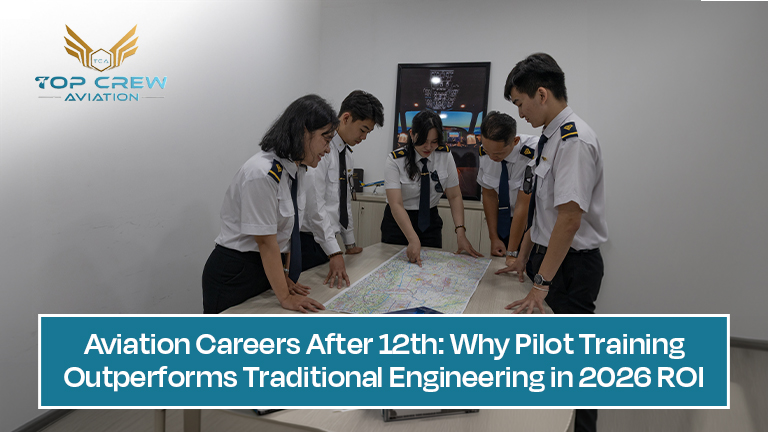
The aviation industry demands technically knowledgeable individuals who can handle their roles in a disciplined and confident way. This has helped many of the students to think about taking up a professional career as a commercial pilot right after Class 12. Aviation training is more specialised and career-focused than traditional academic degrees, with many not getting placed in the industry for several years after they receive their degree.
Aviation training students learn air navigation, meteorology, air regulations, aircraft systems and communication procedures right from the start. Structured flight training in India also incorporates technical aspects with hands-on experience, enhancing the understanding of the aviation environment throughout the training experience.
The recent pilot shortage has also had an impact on students’ thinking about the stability of their careers and potential earnings. The pilot shortage has also affected students’ thinking about the stability of their jobs and how much they will make in the future. In the modern world of aviation, training to build a skill, coupled with operational discipline and technical preparation, has direct consequences on long-term opportunities within the airline industry.
The Use of Flight Simulators in Modern Aviation
Technology has become a valuable aspect of aviation learning environments. Although the training process on a modern flight simulator enables students to learn the procedures they will have in the cockpit, run through emergency tasks, learn navigation, and go through operational scenarios before they get to hands-on flying stages, it is not the same as sitting in a plane. The use of simulators allows students to develop their decision making skills and procedural knowledge in a training environment set into a controlled environment.
In the last decade, learning via a simulator has become the key method of pilot training in professional commercial pilot training programmes, as it can enhance both technical awareness and confidence in an aviation environment and also provide the student with a realistic environment for their training. Other uses of the simulator include participating in sessions for the instructor to assess communication, coordination and operational discipline, before engaging in more advanced training with the instructor.
One of the most significant aspects of flight training opportunities in India for students is the experience with flight simulators. Aviation companies prefer job seekers who have a sound knowledge of the operational procedures and standards for cockpit coordination from their early training stages.
Aviation Careers vs Traditional Engineering
While the traditional engineering curriculum is still relevant in a wide variety of careers, many students are considering aviation careers because they offer a potential positive practical payoff. Typically, engineering education requires more general preparation in the academic field and less subsequent specialisation. Training for aviation transitions, however, is linked from the outset with operational opportunities for careers in aviation.