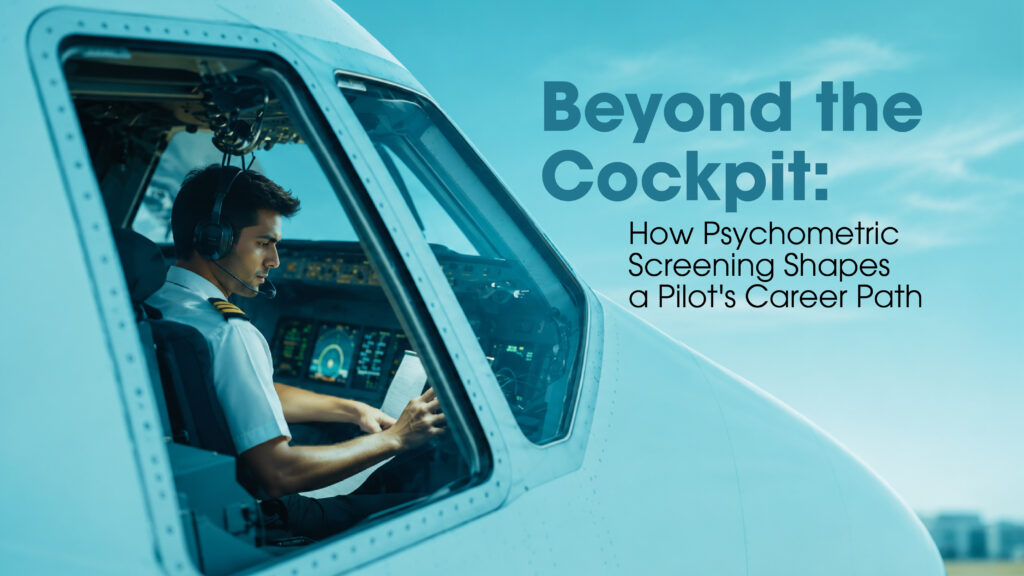
While most aviation aspirants concentrate on accumulating flight hours, scoring well in DGCA exams, and achieving license milestones, what hardly gets any focus, even though it is something important in airline selection, is the psychometric testing component. Airlines in India and overseas have advanced a lot from just assessing the technical skills of their pilot candidates. They also check for mental sharpness, emotional steadiness, the ability to make decisions under stress, and whether one’s personality fits the requirements of a cockpit. For those who want to become commercial pilots, knowing about this part is mandatory. In fact, career planning, including this aspect, should be started well before the day of the interview with the airline.
Psychometric tests in aviation are highly regulated assessments aimed at determining a candidate’s mental fitness for the duties of a pilot. In fact, these evaluations measure much more than just personality traits. Instead, they are a carefully designed set of tools based on research findings about characteristics that can predict pilot performance, successful training completion, and good behaviour over time in the cockpit.
Usually, these tests assess two main but closely linked areas. The first one is cognitive capacity, among other things, which involves numerical reasoning, understanding of the written word, spatial skills, recognising patterns, and managing several tasks at the same time. The second one is personality and behaviour profiling, evaluating characteristics, for example, emotional control, level of risk-taking, dependability, degree of forcefulness, and preference for working as part of a team.
Besides technical interviews, airlines rely on test results because studies reveal that these are strong indicators of an individual’s readiness to become a pilot. One of the features of personality assessment that often leads to a wrong interpretation by candidates is consistency. The design of psychometric tools includes features that allow checking for reliability. If a respondent tries to give fashionable answers to depict themselves in the best light, the changes in patterns of responses will result in a warning.
Most students do not realise that commercial pilot training and psychometric testing are very closely linked. In fact, the mental capabilities, systematic discipline, and operational mindset that students acquire through structured ground school training profoundly influence their scores in aptitude tests. For example, students who have been taught to solve problems methodically by breaking down navigation tasks, understanding weather charts, and handling several regulatory factors at a time are, in a way, constructing the very cognitive blueprint that psychometric tests are designed to capture.
Commercial pilot training that combines airline orientation right from the start results in candidates who, rather than being ignorant of the selection procedures, are relaxed and composed on the day of their assessment. If Crew Resource Management concepts, multi-crew communication methods, and decision-making with safety priority are familiar to students through early training, these will be reflected ultimately in more confident and consistent answers during group discussions and personality tests.
Psychometric tests are a part of the recruitment procedures by airlines like IndiGo and Air India for selecting cadets. The ADAPT and COMPASS tests are among the most popular tools. Selection is done in multiple rounds. Each round shortlists candidates for the next round only, and the psychometric testing round is towards the end. So, besides simulator performance, it is equally essential to be well prepared for the psychometric test round.
Components of a commercial pilot course should be studied extensively, not only using DGCA exam passing percentages or flying hours’ arrangements, but also on whether they prepare students for the entire airline selection process. Most candidates get their CPL and then suddenly think of preparing for aptitude tests and psychometric assessments. Unfortunately, this reactive way of doing things hardly ever results in the outcomes that early structured preparation can bring.
An efficiently planned commercial pilot course will introduce students to the airline environment, will have them go through mock psychometric tests, and will give them interview coaching. These will be some of the training milestones, not ways of adding things on or extra stuff. Students who know what airlines look for before they take their first aptitude test have a significant advantage. Apart from performance, being familiar with psychometric testing early on also enables candidates to recognise the areas where they need to develop, paying attention, behaviour under stress, or the way they communicate, which can be brought to a great level of improvement with time.
Conclusion
Psychometric tests don’t limit an aviation career; they uncover it. They help identify if a candidate has the aptitude to handle the structured, high-stress, team-dependent operational environment of commercial aviation. Without training for psychometric testing, one of the most easily avoidable mistakes leading to failures at the last stage is ignorance of such a test, no matter how little it is yet understood.
Captain P. Kumar started Top Crew Aviation back in 2008, and it is not only situated in Jaipur but also has a branch in New Delhi. Over 17 years of combined flight training instructor experience is the resource this institute intends to meet the challenge most effectively. Their student portfolio extends from DGCA CPL ground theory classes at the level of individual subjects to pilot flying school selection mentoring, simulator exposure, and airline training, inclusive of psychometric test and interview skills coaching. 97% DGCA exam pass rate supported by mentorship based on treating airline selection preparation as a fundamental commitment characterised by Top Crew Aviation, which ensures that its aspirants are well-prepared before going to any testing stage. For more information, visit topcrewaviation.com to initiate professional training.
Psychometric tests are used to evaluate a person's intelligence and personality traits that may be indicative of their ability to perform well in the cockpit. Now, for aspiring commercial pilots, passing these tests is a mandatory requirement for getting through the airline selection process.
Really, commercial pilot training that is well-planned and structured helps develop systematic thinking, a sense of procedural discipline, as well as the ability to do multiple things at once. Interestingly, these are precisely the cognitive features that psychometric tests during the airline cadet selections are intended to identify and assess.
A well-structured commercial pilot course should provide for aptitude coaching, personality assessment simulations, airline interview training, DGCA theoretical classes and flying school instructions.
Top Crew Aviation gives airline-specific preparation, which covers psychometric training, simulated tests, group discussions, and interview skills, assuring that students become capable of meeting the airline's selection criteria even before they submit their applications to the airlines.
Batch Start From 6th Jan & 10th Jan 2025
Batch Start From 10th Jan 2025