Why Indian CPL Holders Not Getting Airline Jobs | Complete Guide
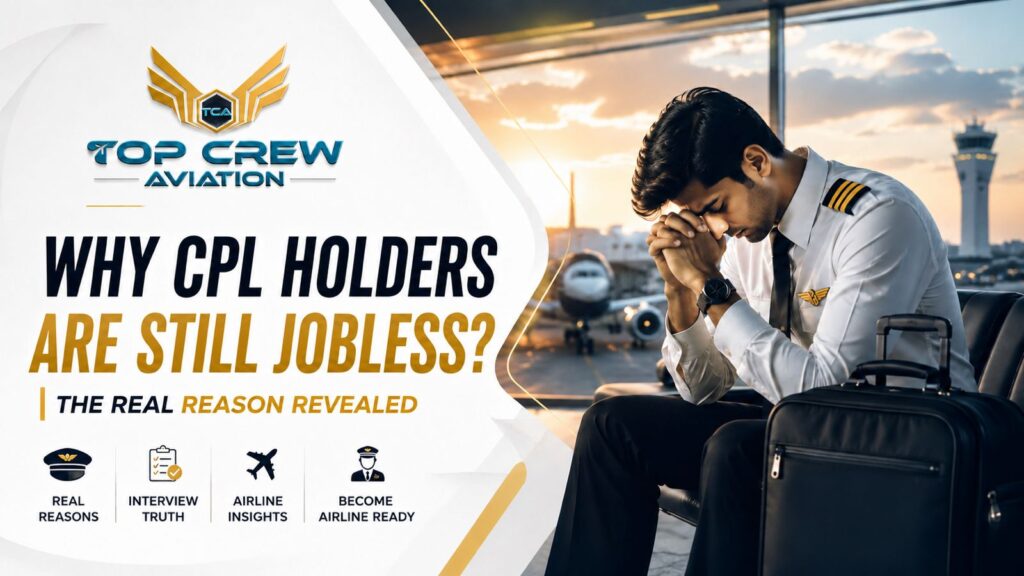
Every week, aviation forums and social media platforms across India are flooded with comments like:
“There are no pilot jobs in India.”
“I completed my CPL two years ago and I am still sitting at home.”
“Flight training is a bad investment.”
These statements create intense anxiety and confusion among aspiring pilots and their families.
But are these claims actually true? The short answer is No.
India is currently one of the fastest-growing civil aviation markets in the world. Airlines are expanding rapidly, new greenfield airports are opening, and fleet orders are at historic highs. Yet, hundreds of Commercial Pilot Licence (CPL) holders wait months—or even years—for their first airline induction.
If airlines urgently need pilots, why are so many CPL holders unemployed? The answer lies in a single, critical distinction: Holding a licence is not the same as being airline-ready.
Is There Really a Pilot Job Crisis in India?
There is a fundamental difference between a shortage of jobs and a shortage of candidates who meet airline standards.
A DGCA Commercial Pilot Licence (CPL) is simply the statutory minimum requirement to submit an application. It is an eligibility criterion, not an entitlement or guarantee of employment.
💡 The Medical Analogy
Earning an MBBS degree legally qualifies someone to practice medicine, but top hospitals still conduct rigorous technical interviews, clinical evaluations, and residency screenings before hiring. Aviation operates on the exact same principle.
Getting your CPL is not the finish line—it is merely your entrance ticket to the professional selection process.
The Growing Demand for Pilots in India
The macro-economic fundamentals of Indian aviation have never been stronger:
- ✈️ 3rd Largest Domestic Market: India continues its rapid rise in global passenger traffic rankings.
- 🌐 UDAN Regional Connectivity Scheme: Dozens of Tier-2 and Tier-3 airports are operational, driving demand for regional turboprop and jet fleets.
- 📦 1,700+ Record Aircraft Orders: Major Indian carriers—including IndiGo, Air India Group, and Akasa Air—have placed historic firm orders for narrowbody and widebody jets.
- 👨✈️ 15,000+ Pilots Required by 2035: According to long-term market outlooks by Boeing and Airbus, South Asia will require tens of thousands of new pilots over the next decade, with India leading the demand.
The jobs exist. The real bottleneck is candidate preparation and quality during airline recruitment drives.
Why Thousands of CPL Holders Remain Unemployed
After evaluating hundreds of CPL holders over the years, a clear pattern emerges: Most candidates are technically qualified on paper, but professionally unprepared in practice.
What Candidates Have On Paper:
- Valid DGCA CPL & Class 1 Medical
- Required 200 Flying Hours completed
- Multi-Engine & Instrument Ratings
- Memorized theoretical answers for DGCA exams
Where Candidates Struggle in Selection:
- Technical viva & operational flying logic
- Scenario-based problem solving
- Aviation English fluency & standard radio phraseology
- Multi-crew simulator coordination (CRM)
- Professional attitude, humility, and trainability
Airlines are not just hiring CPL holders—they are recruiting future First Officers and Captains.
The 5 Biggest Reasons Pilots Don’t Get Selected
1. Poor Technical Viva Preparation
Many candidates spend months preparing for DGCA written exams but only a few days preparing for technical panel interviews. Candidates often rely on memorized question banks instead of deeply understanding aircraft systems, meteorology, aerodynamics, and air regulations.
2. Weak Aviation Communication Skills
Clear, structured, and confident communication is a vital safety tool in high-consequence flight operations. Candidates frequently lose marks during interviews because they speak too fast, give vague answers, or struggle to explain technical concepts simply in professional cockpit English.
3. Lack of Airline Awareness
A surprising number of candidates attend airline interviews with zero knowledge about the airline’s operational fleet, engine types, route network, company values, or recent expansion plans. Thorough company research demonstrates discipline and genuine motivation.
4. Deficient Simulator Performance
Simulator check-rides evaluate your manual flight raw-data skills, instrument scan, SOP compliance, and Crew Resource Management (CRM) under stress. Cadets who haven’t practiced scenario-based multi-crew profiles often suffer task saturation during their assessment.
5. Unsuitable Professional Attitude
Airlines evaluate your trainability and executive presence. Candidates who become defensive when corrected, fail to admit knowledge gaps, or show arrogance are quickly eliminated.
Minimum CPL Qualification vs. Airline Expectation
| Assessment Parameter | DGCA CPL Paper Minimum | Airline Selection Expectation |
|---|---|---|
| Flight Experience | Basic 200 Hours (Single/Multi Engine) | High situational awareness & raw-data scan |
| Technical Knowledge | Rote memory of DGCA question banks | Scenario-based system problem solving & logic |
| Crew Concept | Single-pilot flying mindset | Multi-Crew Cooperation (MCC) & CRM principles |
| Communication | Basic RTR exam clearance | Clear, professional aviation phraseology & English |
| Professional Mindset | Student/Cadet attitude | Executive presence, trainability, and accountability |
The 6-Stage Airline Recruitment Pipeline
- Stage 1: Application & Logbook Audit – Verification of flying hours, DGCA licences, medicals, and educational credentials.
- Stage 2: Computerized Aptitude Test – Evaluation via ADAPT, CASS, or COMPASS testing physics, spatial awareness, and multitasking.
- Stage 3: Technical Panel Viva – Intensive face-to-face evaluation by senior captains on aerodynamics, systems, weather, and regulations.
- Stage 4: HR & Behavioral Interview – Assessment of personality, emotional intelligence, stress tolerance, and company alignment.
- Stage 5: Simulator Assessment Check – Real-time test of manual flying skills, SOP compliance, raw-data tracking, and CRM in a multi-engine simulator.
- Stage 6: Induction & Type Rating Batch – Formal employment offer, company medicals, and assignment to aircraft ground school.
How to Become Truly “Airline Ready”
Instead of asking, “When will airlines start hiring?”
Ask yourself: “If an airline calls me for evaluation tomorrow, am I 100% ready?”
Actionable Preparation Steps:
- Systematic Technical Revision: Rotate daily through Air Law, Meteorology, General Navigation, and Aircraft Technical subjects.
- Practice Technical Mock Panels: Conduct mock interviews out loud with senior pilots and mentors to build vocal confidence.
- Invest in Target Simulator Prep: Practice multi-crew cooperation, raw-data instrument flying, and emergency briefings in a simulator.
- Audit Your Logbook & Documents: Keep all flight hours, endorsements, and DGCA paperwork immaculately updated and error-free.
- Stay Industry Updated: Follow DGCA Civil Aviation Requirements (CARs), fleet expansion news, and global aviation trends.
Expert Advice from an Airline Instructor
“During my years on selection panels, I have noticed one consistent truth: Candidates who prepare only to pass exams struggle in airline interviews. Candidates who prepare to be professional aviators succeed.
The airline panel is not trying to trick you. They are evaluating one fundamental question: ‘Would I trust this person in the cockpit beside me on a stormy night with 180 passengers behind us?’
Technical knowledge earns your seat in the selection hall. Character, communication, and professionalism earn you the job.”
— Capt.
Frequently Asked Questions (FAQs)
Q1. Is there a shortage of pilot jobs in India?
No. Indian carriers have placed orders for over 1,700 aircraft, creating demand for thousands of pilots over the next decade. However, airlines maintain strict selection standards, and only candidates who clear technical, behavioral, and simulator benchmarks are hired.
Q2. How long does it take to get an airline job after completing a CPL?
On average, fresh CPL holders take between 6 to 18 months to secure an airline role. This timeline depends on recruitment schedules, candidate preparation level, and how consistently a pilot studies during their waiting period.
Q3. Are flying hours the only factor airlines consider during hiring?
No. Flying hours satisfy the initial screening eligibility. Once shortlisted, airlines evaluate technical depth, decision-making, CRM, communication, and simulator performance.
Q4. Should I prepare separately for airline selection, or are DGCA ground classes enough?
Yes, separate preparation is essential. DGCA ground classes focus on clearing theoretical written exams. Airline selection requires application-based problem solving, viva presentation skills, simulator scan practice, and multi-crew coordination.
Q5. What is the biggest mistake fresh CPL holders make?
The biggest mistake is stopping preparation after getting the CPL licence. Many candidates wait passively for recruitment drives to open before studying, leading to poor performance when short-notice interview calls arrive.
Final Thoughts
A Commercial Pilot Licence opens the door, but your technical competence, communication, discipline, and executive presence are what help you walk through it.
Treat your post-CPL period not as “unemployment,” but as your airline preparation phase. Focus on continuous learning, refine your skills daily, and when your opportunity comes, you will be ready to claim your seat in the cockpit.
Why Indian CPL Holders Are Not Getting Airline Jobs | Complete Guide & Reality Check
Why Indian CPL Holders Struggle to Get Airline Jobs | Aviation Reality & Guide
Discover why thousands of CPL holders in India remain unemployed despite 1,700+ aircraft orders. Learn the 5 major selection bottlenecks and how to become truly airline-ready.
Why Indian CPL Holders Are Not Getting Airline Jobs
Every week, aviation forums and social media platforms across India are flooded with comments like:
“There are no pilot jobs in India.”